
Modern urban mobility platforms operate under intense pressure from fluctuating demand, real time expectations, and complex operational dependencies. Taxi applications must process large volumes of location data, pricing calculations, and concurrent user requests without disruption. When teams set out to Develop Taxi app solutions for long term growth, scalability and performance become foundational concerns rather than afterthoughts. These systems must respond instantly, remain reliable during peak usage, and adapt gracefully as geographic coverage and feature complexity expand over time.
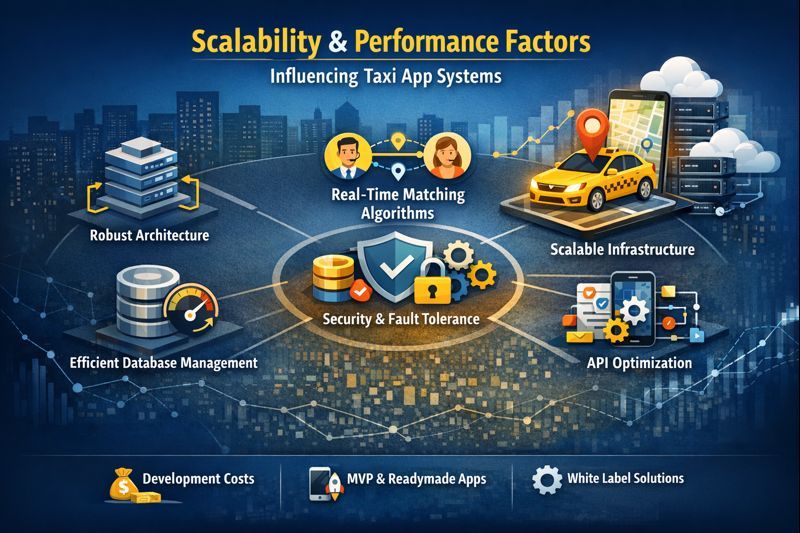
Architectural foundations that enable scalable taxi app platforms
Scalability begins with architectural decisions made at the earliest design stage. A modular, service oriented architecture allows individual components to scale independently, reducing systemic bottlenecks. Monolithic designs often struggle when user demand spikes unpredictably, while loosely coupled services provide greater resilience.
Key architectural principles include:
- Clear separation between user interfaces, business logic, and data layers
- Stateless service components to simplify horizontal scaling
- Event driven communication for handling asynchronous tasks such as ride status updates
- Isolation of critical services like payments and dispatch logic
When organizations Develop Taxi app systems with future expansion in mind, these principles support geographic growth, feature experimentation, and operational stability without frequent reengineering.
Infrastructure choices affecting performance under high demand
Infrastructure selection directly influences how a taxi platform performs during peak hours. Cloud based environments offer elasticity, enabling systems to allocate resources dynamically in response to demand surges such as rush hours or weather disruptions.
Performance focused infrastructure decisions typically involve:
- Load balancers to distribute traffic evenly across application instances
- Auto scaling groups that respond to real time usage metrics
- Geographic distribution of servers to minimize latency for riders and drivers
- Containerization to ensure consistent deployments across environments
Poor infrastructure planning can lead to slow response times, dropped requests, and degraded user trust. A well designed infrastructure ensures that the platform remains responsive even as active user counts multiply.
Database design strategies for real time mobility workloads systems
Taxi applications rely heavily on databases to manage trip records, user profiles, and location streams. Traditional relational databases alone may not handle the velocity and volume of real time mobility data efficiently.
Effective database strategies often combine multiple technologies:
- Relational databases for transactional integrity and financial records
- NoSQL stores for high velocity location updates and session data
- In memory caching layers to reduce read latency for frequently accessed data
- Data partitioning and sharding to distribute load across nodes
Indexes and query optimization are equally critical. Poorly optimized queries can slow down dispatch algorithms and pricing calculations, undermining overall system performance during high traffic periods.
API efficiency and service orchestration in taxi ecosystems globally
Application programming interfaces form the backbone of interactions between mobile clients, backend services, and third party integrations. Inefficient APIs can introduce latency that compounds across the system.
Optimizing API performance involves:
- Designing concise request and response payloads
- Implementing rate limiting to protect backend services
- Using asynchronous processing where immediate responses are not required
- Coordinating service orchestration to avoid unnecessary inter service calls
As taxi platforms expand into broader ecosystems involving mapping, payments, and analytics providers, disciplined API management becomes essential to maintain consistent performance at scale.
Real time matching algorithms and their scalability limits analysis
Ride matching algorithms are among the most computationally intensive components of taxi systems. They must balance proximity, driver availability, pricing logic, and user preferences within milliseconds.
Scalability challenges often arise from:
- Increasing geographic coverage with dense urban traffic patterns
- Simultaneous ride requests during peak demand windows
- Complex pricing models incorporating surge and incentive rules
To mitigate these challenges, platforms use techniques such as zone based matching, heuristic filtering, and predictive demand modeling. Continuous tuning of these algorithms is required to ensure fairness, efficiency, and responsiveness as the system grows.
Security, compliance, and fault tolerance at platform scale levels
As taxi applications scale, they become attractive targets for security threats and must comply with evolving regulatory requirements. Performance considerations cannot be separated from security and reliability planning.
Critical focus areas include:
- Encryption of sensitive data both in transit and at rest
- Role based access controls for administrative and operational tools
- Redundant services and failover mechanisms to maintain uptime
- Regular audits and monitoring for anomalous behavior
Fault tolerance ensures that localized failures do not cascade into system wide outages, preserving user confidence and operational continuity.
Operational monitoring metrics and continuous optimization practices
Scalable systems require continuous visibility into performance metrics. Without effective monitoring, issues may remain undetected until they impact users.
Commonly tracked metrics include:
- API response times and error rates
- Database query performance and connection usage
- Resource utilization across compute and storage layers
- Ride lifecycle timings from request to completion
These insights inform ongoing optimization efforts. Performance tuning, capacity planning, and incident response all depend on accurate, real time operational data supported by disciplined monitoring practices.
Cost considerations and build approaches for evolving taxi apps
Scalability decisions carry long term financial implications. Understanding the cost to build taxi app platforms involves more than initial development expenses; it includes infrastructure, maintenance, and optimization over time.
Different build approaches influence scalability and cost profiles:
- A white label taxi app may accelerate deployment but limit architectural flexibility
- MVP app development services can validate demand while controlling early investment
- A readymade app reduces time to market but may constrain customization
Balancing upfront cost efficiency with long term scalability requires careful evaluation of technical tradeoffs and anticipated growth trajectories, particularly when teams Develop Taxi app solutions intended for competitive markets.
Conclusion
Sustaining high performance in taxi platforms demands a holistic approach that spans architecture, infrastructure, data management, and operations. Scalability is not achieved through a single technology choice but through disciplined engineering practices applied consistently across the system lifecycle. By aligning technical decisions with realistic growth expectations and continuously refining performance strategies, organizations can support reliable mobility services that adapt effectively to changing user demands and operational complexity over time.