
Building a ride-hailing platform is not only a question of features and user experience but also of foundational technical decisions. System architecture determines how reliably a platform performs, how easily it adapts to growth, and how efficiently it handles real-world complexity. Organizations that plan to Develop Taxi app solutions for long-term usage must evaluate architectural trade-offs early, as these choices influence scalability, security, maintenance, and cost control over many years of operation.
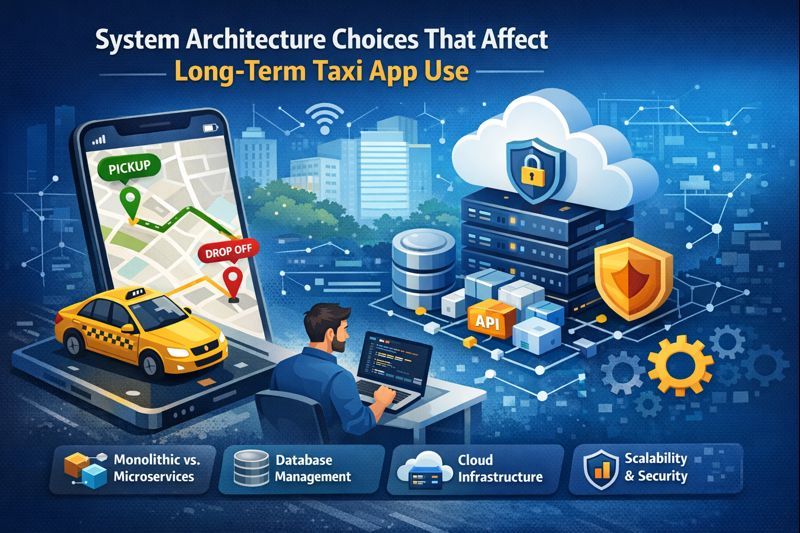
Why system architecture decisions shape scalable taxi platforms
System architecture is the structural blueprint that defines how different components of a ride-hailing platform interact. It governs data flow, service communication, fault tolerance, and extensibility. Early architectural decisions can either enable smooth growth or create constraints that surface only when the user base expands.
A well-designed architecture supports predictable performance during peak hours, such as commuting times or special events. It also simplifies future enhancements, including new pricing models or regional expansions. Conversely, weak architectural planning often leads to technical debt, where quick fixes accumulate and slow innovation.
Key architectural objectives typically include:
- High availability to prevent service disruption.
- Low latency for real-time matching and navigation.
- Maintainability to reduce operational complexity.
- Flexibility to accommodate regulatory or market changes.
Each objective must be balanced carefully, as over-optimizing one area may introduce weaknesses in another.
Choosing between monolithic and microservices architectures models
One of the earliest architectural choices involves selecting between monolithic and microservices models. A monolithic architecture consolidates all functionalities into a single codebase. This approach can simplify initial development and deployment, especially for teams validating a concept through MVP app development services.
Microservices architecture, by contrast, decomposes the system into independently deployable services. Each service handles a specific business capability, such as payments, driver management, or trip analytics. This model enhances scalability and fault isolation but introduces operational complexity.
Considerations when selecting an approach include:
- Team expertise and DevOps maturity.
- Expected growth rate and geographic expansion.
- Integration requirements with third-party systems.
- Long-term maintenance strategy.
Some organizations initially adopt a monolithic structure and later transition to microservices as usage grows. Others leverage a white label taxi app to accelerate launch while planning a gradual architectural evolution.
Database design strategies for real-time ride matching operations
Databases play a central role in managing users, drivers, trips, payments, and historical analytics. Real-time ride matching requires fast read and write operations, geospatial queries, and consistent data synchronization across services.
Relational databases provide strong consistency and transactional integrity, which are valuable for billing and user records. NoSQL databases offer flexibility and horizontal scalability, making them suitable for location tracking and event logging.
A balanced data strategy often involves:
- Using relational databases for critical transactional data.
- Deploying in-memory data stores for caching frequently accessed information.
- Leveraging geospatial indexing for efficient proximity searches.
- Implementing replication and sharding for high availability.
Poor database design can lead to bottlenecks that affect rider wait times and driver utilization, making this an area that demands careful long-term planning.
API layer planning for performance, security, and integration
The API layer acts as the communication bridge between mobile applications, backend services, and external systems. Well-structured APIs ensure consistent data exchange and simplify future integrations.
Performance considerations include minimizing payload sizes and reducing round-trip latency. Security considerations involve authentication, authorization, and protection against abuse. Integration considerations address how easily new services or partners can connect to the platform.
Effective API planning typically includes:
- Clear versioning to support backward compatibility.
- Rate limiting to prevent misuse and ensure fairness.
- Token-based authentication for secure access.
- Comprehensive logging for monitoring and troubleshooting.
As organizations Develop Taxi app ecosystems with multiple stakeholders, a robust API strategy becomes essential for maintaining stability while enabling growth.
Cloud infrastructure choices impacting uptime and cost efficiency
Cloud infrastructure underpins deployment, scalability, and operational resilience. Selecting appropriate cloud services influences system uptime and operational predictability. Decisions around compute models, storage options, and networking architecture should align with usage patterns.
For example, auto-scaling capabilities help manage fluctuating demand without manual intervention. Managed services can reduce maintenance overhead but may limit customization. Infrastructure planning also affects the cost to build taxi app initiatives over time, as inefficient resource allocation can inflate operational expenses.
Common infrastructure considerations include:
- Redundancy across regions for disaster recovery.
- Monitoring and alerting for proactive issue resolution.
- Cost optimization through usage-based pricing models.
- Compliance with data residency and privacy regulations.
A thoughtful cloud strategy balances resilience with fiscal responsibility.
Scalability planning to support growth and peak demand periods
Scalability is not only about handling more users but also about sustaining performance during demand spikes. Ride-hailing platforms experience uneven traffic patterns, requiring systems that scale dynamically without service degradation.
Horizontal scaling, where additional instances handle increased load, is often preferred over vertical scaling. Load balancers distribute traffic evenly, while asynchronous processing manages background tasks efficiently.
Scalability planning should address:
- Stateless service design for easier replication.
- Queue-based processing for non-critical workflows.
- Graceful degradation to maintain core functionality under stress.
- Capacity forecasting based on historical usage data.
When teams Develop Taxi app platforms with scalability in mind, they reduce the risk of outages that erode user trust.
Security architecture considerations for user and driver data
Security architecture safeguards sensitive information such as personal details, payment data, and real-time location coordinates. Breaches not only harm users but also expose organizations to regulatory penalties and reputational damage.
A layered security approach is essential. This includes network-level protections, application-level safeguards, and data-level encryption. Access controls should follow the principle of least privilege, ensuring that services and personnel access only what is necessary.
Critical security measures include:
- End-to-end encryption for data in transit.
- Encryption at rest for stored information.
- Regular security audits and vulnerability assessments.
- Incident response plans for rapid containment.
Security should be embedded into architectural design rather than treated as an afterthought.
Planning future enhancements through modular system components
Long-term success depends on the ability to introduce new features without destabilizing existing operations. Modular system components support incremental enhancements, such as loyalty programs, alternative payment methods, or analytics dashboards.
Modularity also allows organizations to evaluate options like a readymade app as a temporary solution while designing custom extensions. Clear boundaries between components reduce dependency conflicts and simplify testing.
Effective modular planning involves:
- Defining clear service responsibilities.
- Standardizing communication protocols.
- Documenting interfaces and data contracts.
- Establishing governance for architectural changes.
This approach ensures that innovation remains manageable as the platform evolves.
Long-term architectural alignment for sustainable platform success
Sustainable platforms emerge from architectural decisions that align technology with business objectives and user expectations. Thoughtful planning across data, infrastructure, security, and scalability creates a foundation that supports reliability and adaptability. By revisiting architectural assumptions periodically and responding to operational insights, organizations can maintain performance while accommodating change. Long-term alignment is not achieved through a single decision but through continuous evaluation and disciplined execution, ensuring the platform remains resilient, efficient, and capable of meeting future demands.
Conclusion
Long-term success in ride-hailing platforms depends heavily on making informed architectural decisions from the outset. Choices related to system structure, data management, infrastructure, scalability, and security directly influence reliability, adaptability, and operational efficiency over time. A well-aligned architecture reduces technical debt, supports consistent performance under changing demand, and enables thoughtful evolution as user expectations and regulatory conditions shift. By prioritizing flexibility, resilience, and maintainability, organizations can ensure their platforms remain robust, efficient, and capable of delivering dependable service well into the future.